+31 685280747
jjhgeldenhuys@gmail.com
+31 685280747
jjhgeldenhuys@gmail.com
HABANERO
Premium chilli with multiple market channels
Potential channels include fresh chillies, dried product, flakes, powders, sauces and ingredient supply, depending on buyer requirements and processing infrastructure.
TURMERIC
Spice and botanical ingredient opportunity
Turmeric can serve food, wellness and processing markets, with focus on rhizome quality, clean production, drying or curing protocols, traceability and reliable supply.

Agriculture across Southern Africa is entering a period in which productivity alone is no longer enough. Farmers and agricultural businesses increasingly need to respond to changing weather patterns, water constraints, soil-health challenges and demanding international markets, while at the same time creating employment and economic opportunities for local communities.
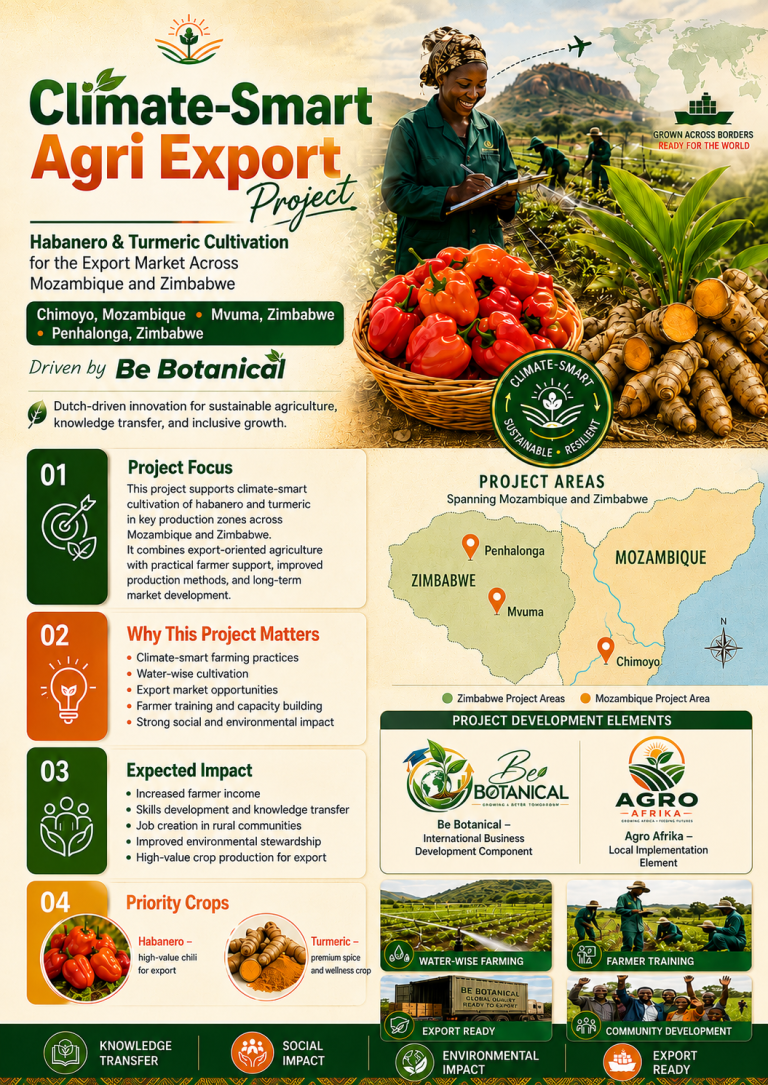
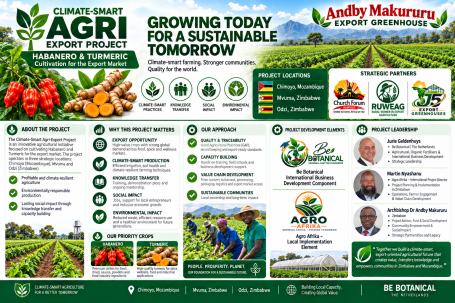
The Climate-Smart Agri Export Project has been developed around this challenge and opportunity. The initiative focuses on cultivating two high-value crops — Habanero chilli and Turmeric — while building a commercially sustainable agricultural model based on climate-smart production, knowledge transfer, social development, environmental responsibility and access to international markets.
Driven by Be Botanical from the Netherlands, the project combines international agricultural and business-development expertise with local ownership and implementation. Rather than viewing farming simply as the production of crops, the project aims to create an integrated value chain in which production quality, farmer knowledge, soil health, traceability, post-harvest handling and export-market requirements are addressed together.
A Southern African Project with an International Vision
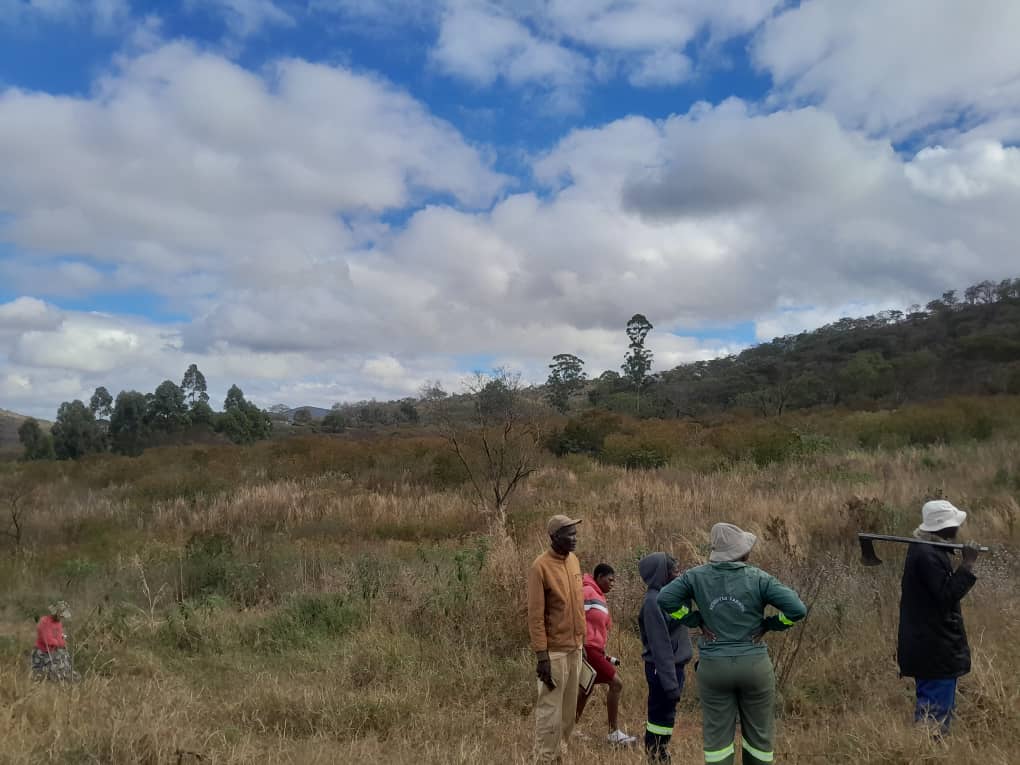
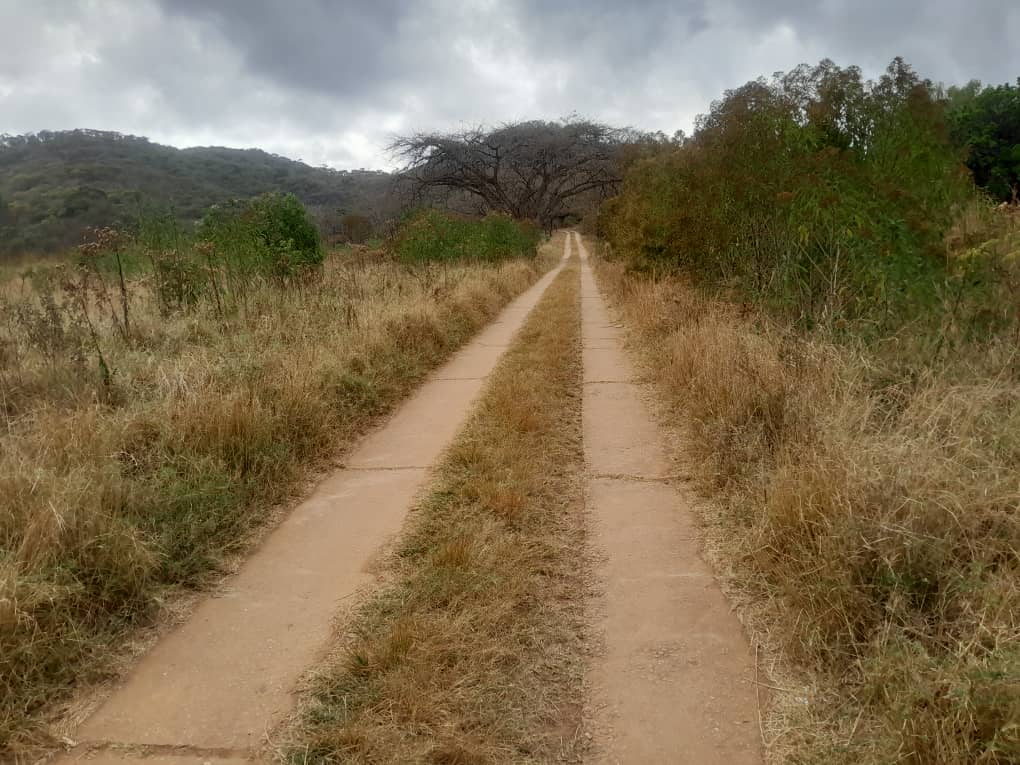
The project operates across three strategic agricultural locations in two Southern African countries.
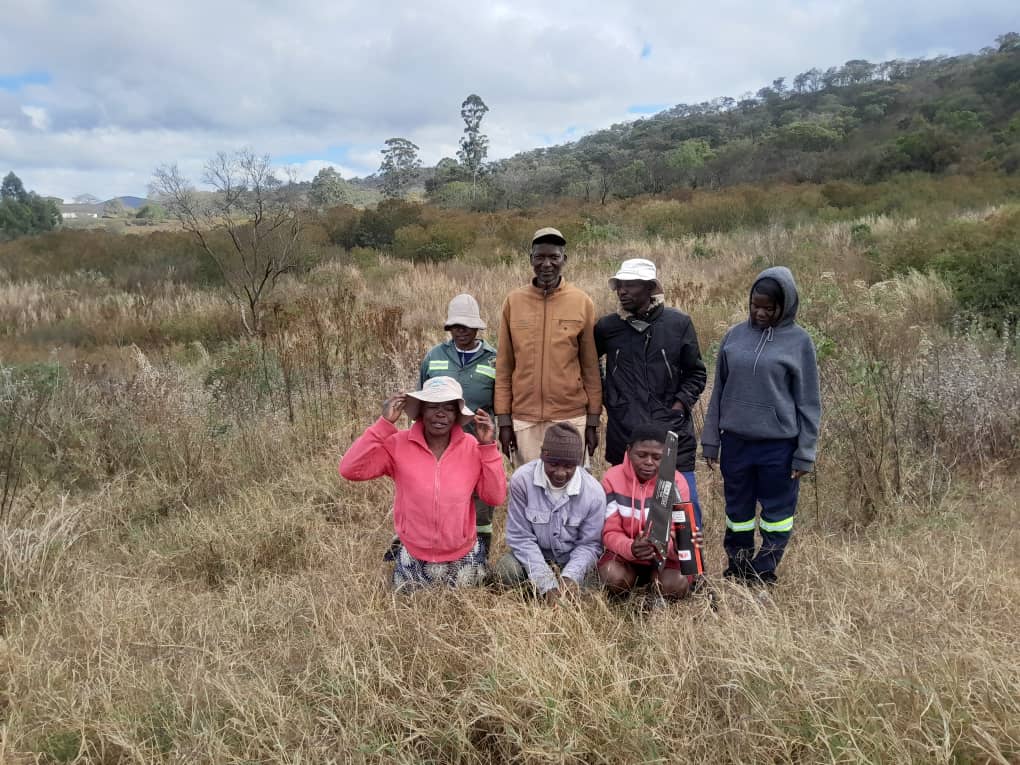
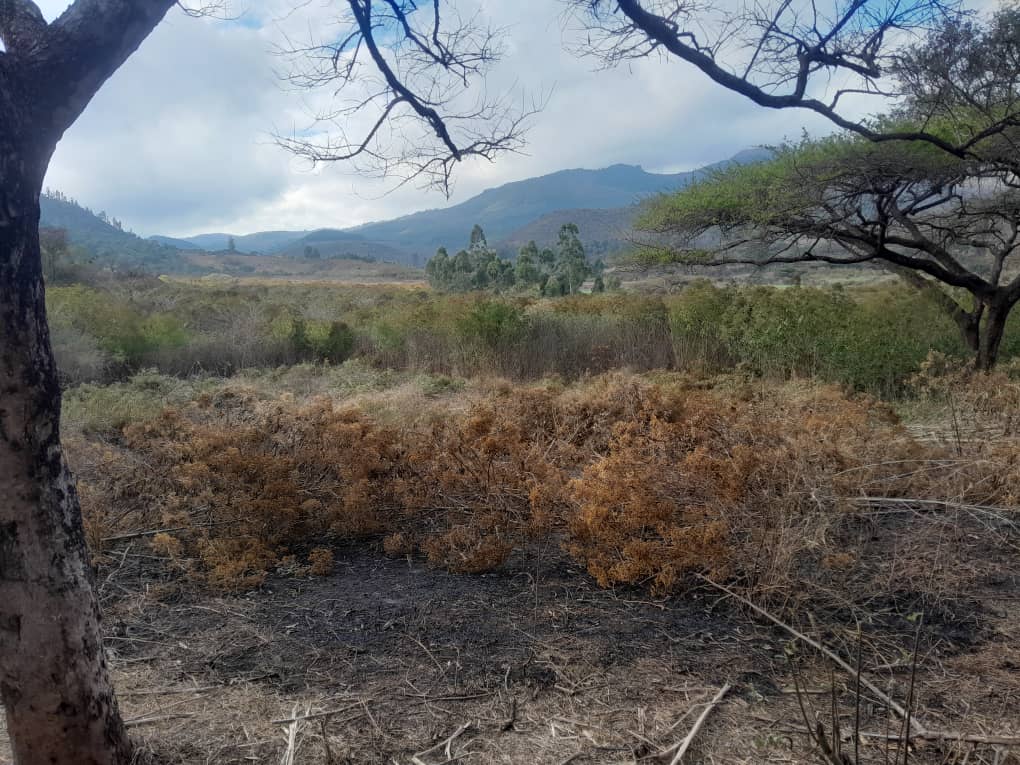
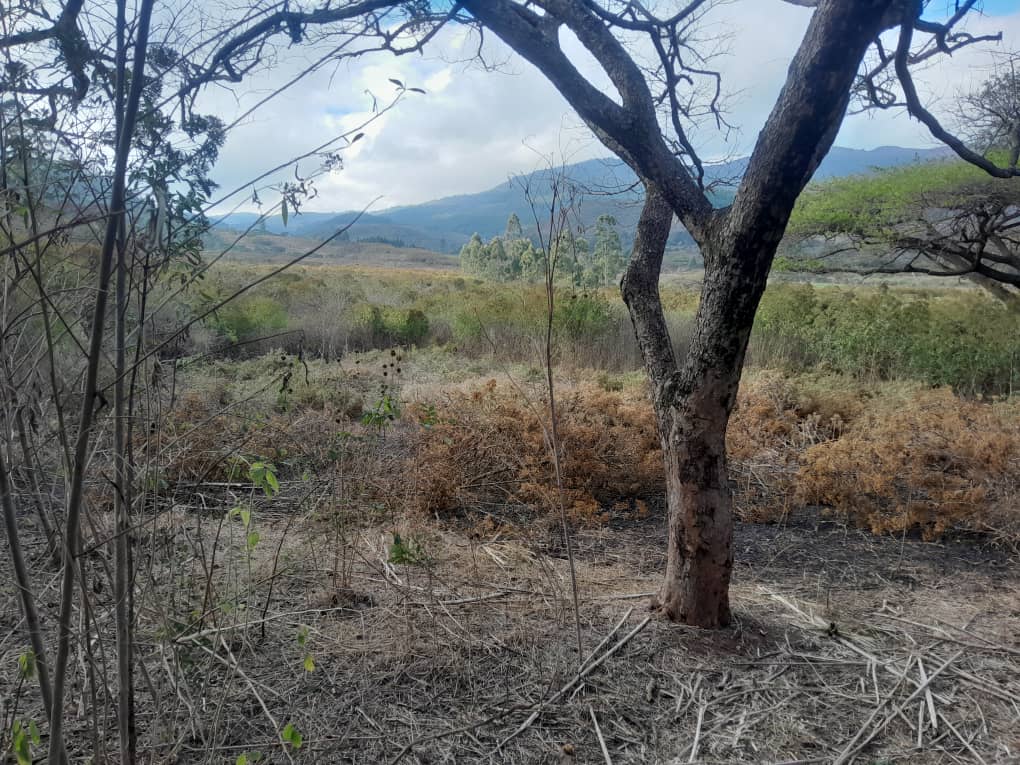
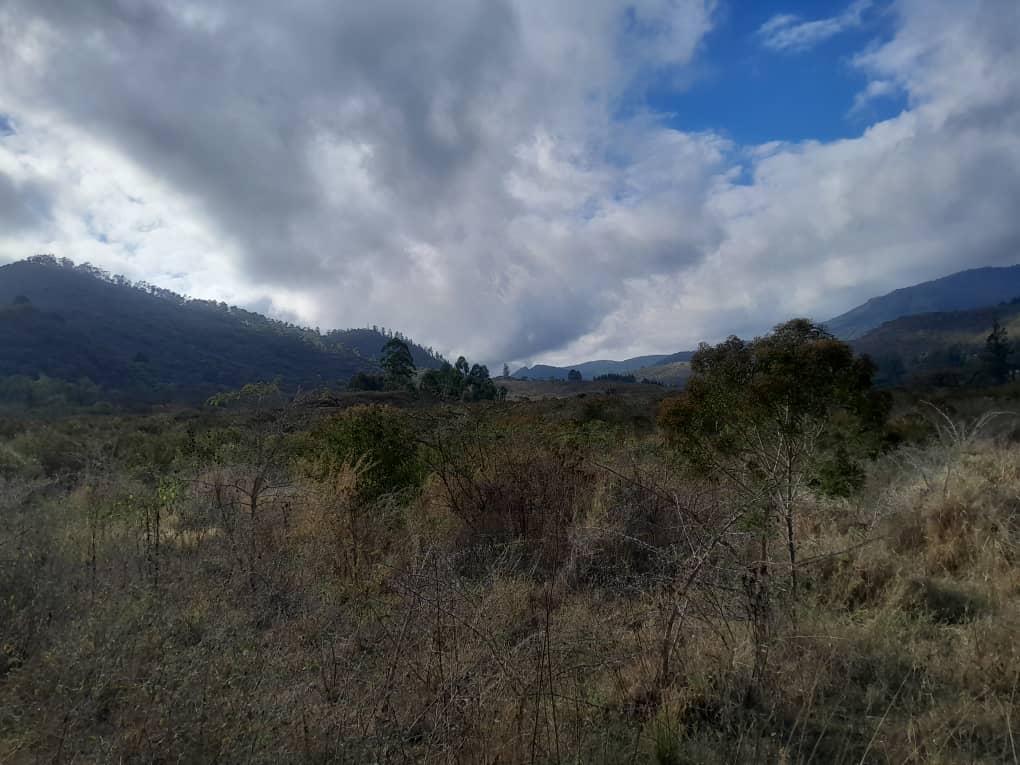
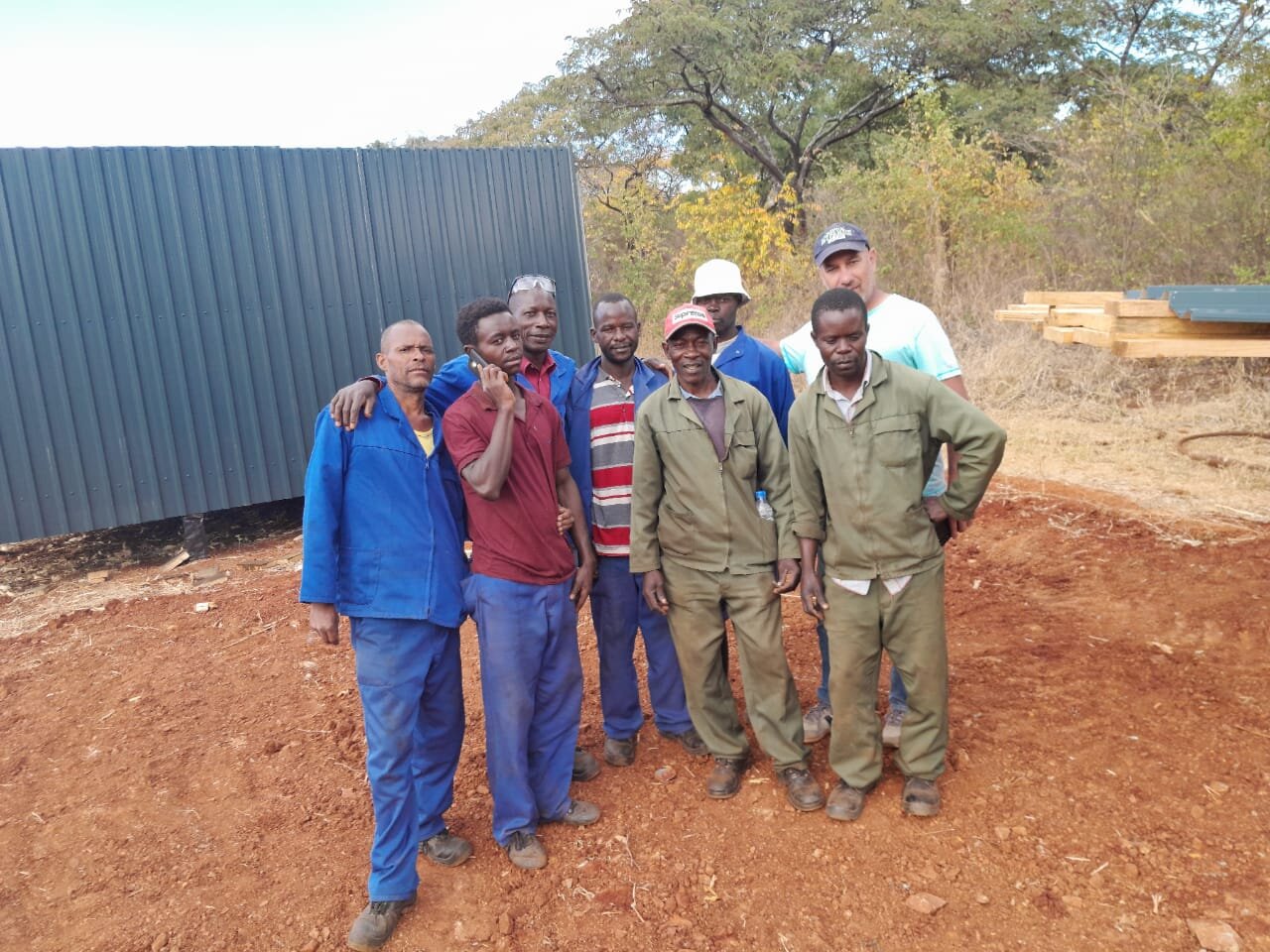
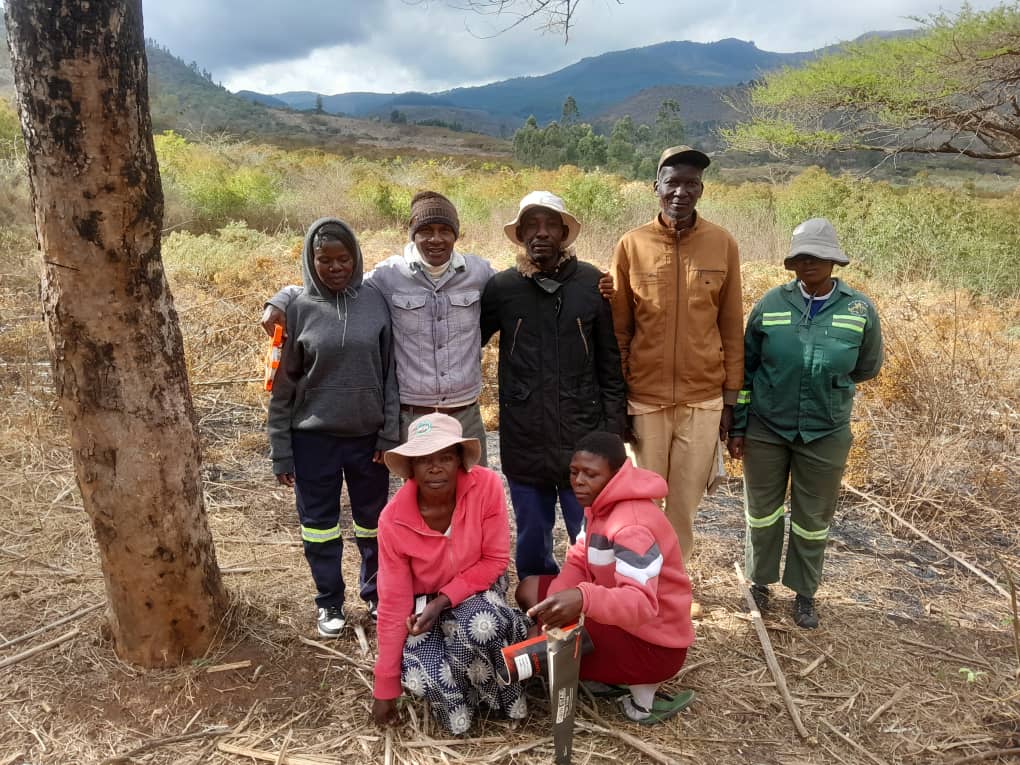
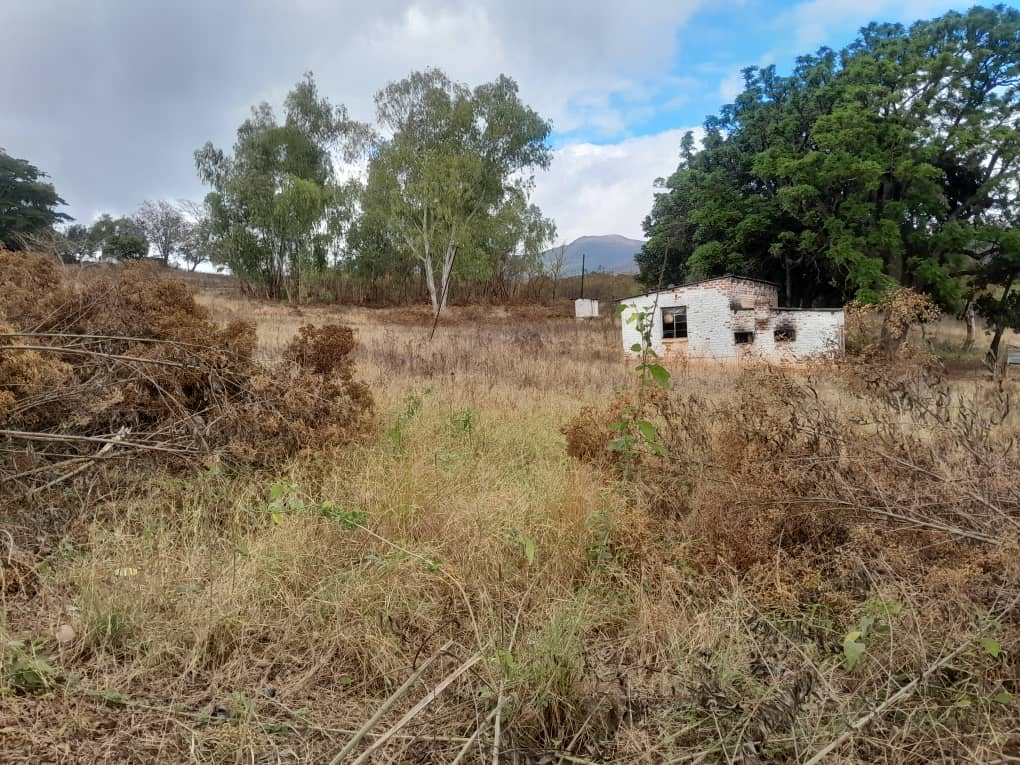
Chimoyo in Mozambique provides a production and learning area where the climate-smart agricultural model can be introduced and developed. In Zimbabwe, Mvuma serves as an implementation area supporting farmer training, diversified production and community participation, while Penhalonga expands the project's production footprint and contributes to the development of a scalable multi-location network.
Although the three production areas have their own local conditions and opportunities, they share one objective: to develop reliable, high-quality agricultural production capable of meeting international market expectations.
The multi-location approach also creates an opportunity to learn. Production methods can be tested under different conditions, lessons can be transferred between sites and successful systems can eventually be replicated in other suitable agricultural regions.
Why Habanero and Turmeric?
Habanero and Turmeric were selected because both crops have the potential to participate in higher-value international markets.
Habanero is a premium chilli with several possible commercial channels. Depending on buyer requirements and processing infrastructure, the crop can potentially be sold as fresh chillies or processed into dried products, flakes, powders, sauces and food ingredients.
Turmeric offers opportunities across food, spice, wellness and processing markets. Commercial success depends on maintaining good rhizome quality, clean production practices, appropriate drying or curing systems, reliable traceability and consistent supply.
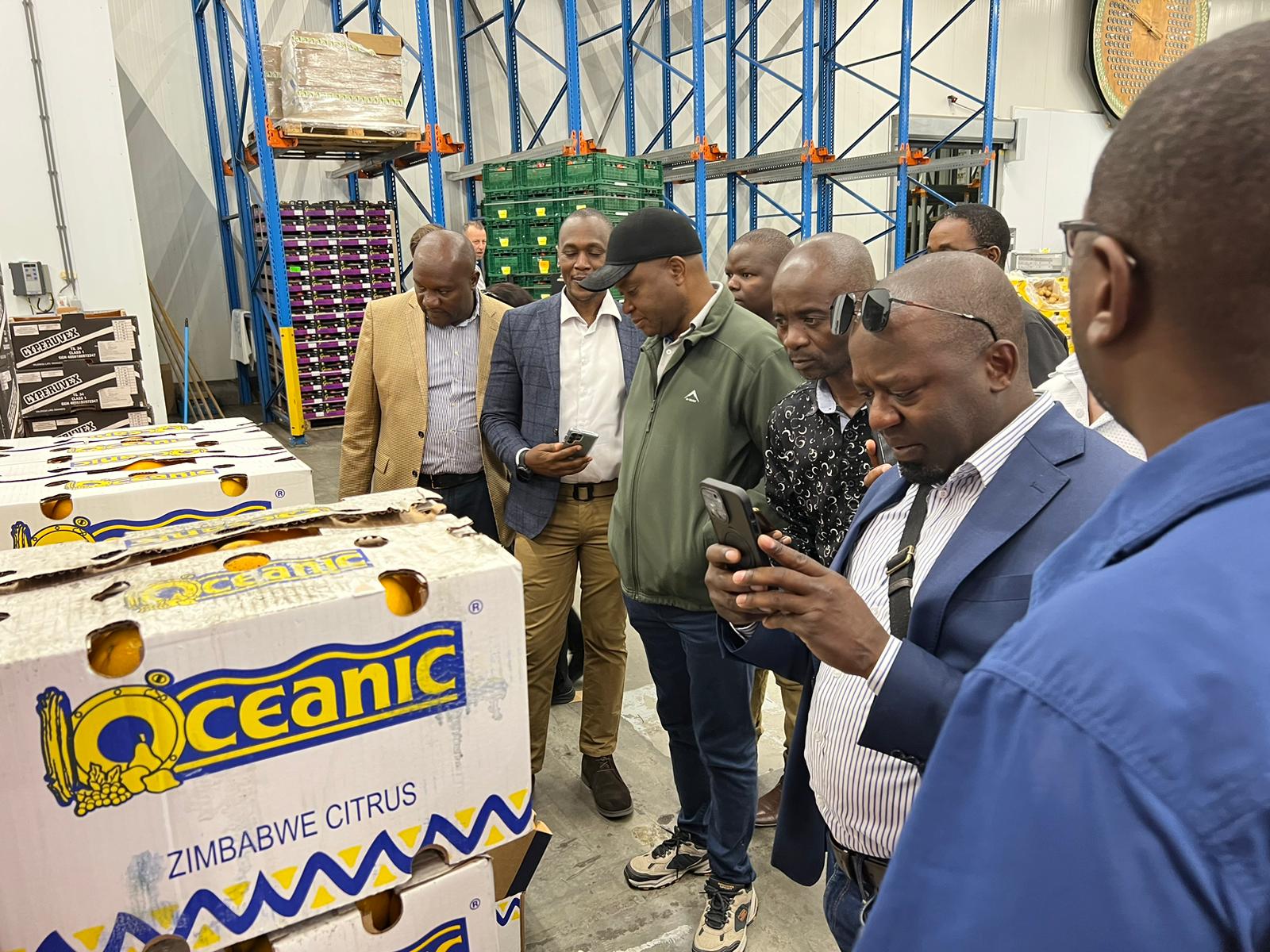
For both crops, the project is deliberately designed around more than yield. Production must ultimately meet the expectations of international buyers. This means quality management, traceability, grading, post-harvest handling, logistics and market specifications need to become part of the farming system from the beginning.
Climate-Smart Farming as a Commercial Strategy
Climate-smart agriculture is at the heart of the project.
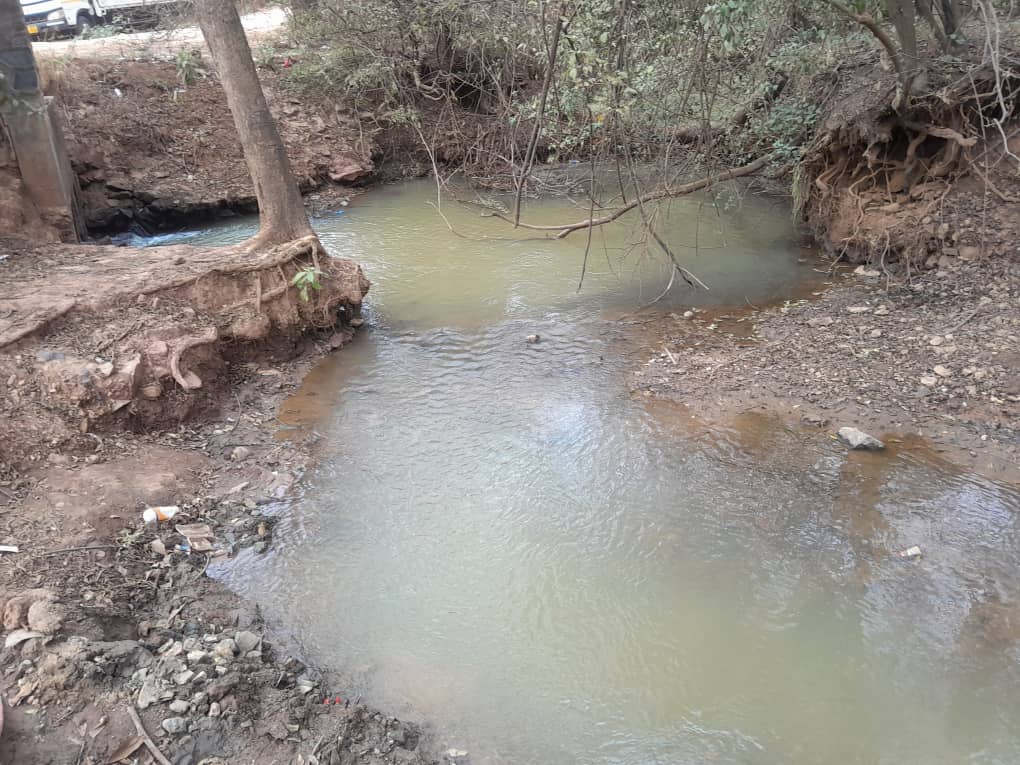
Water-wise irrigation, improved soil management, efficient plant nutrition, crop monitoring and disciplined farm planning are intended to help farmers use resources more effectively while improving the resilience of production systems.
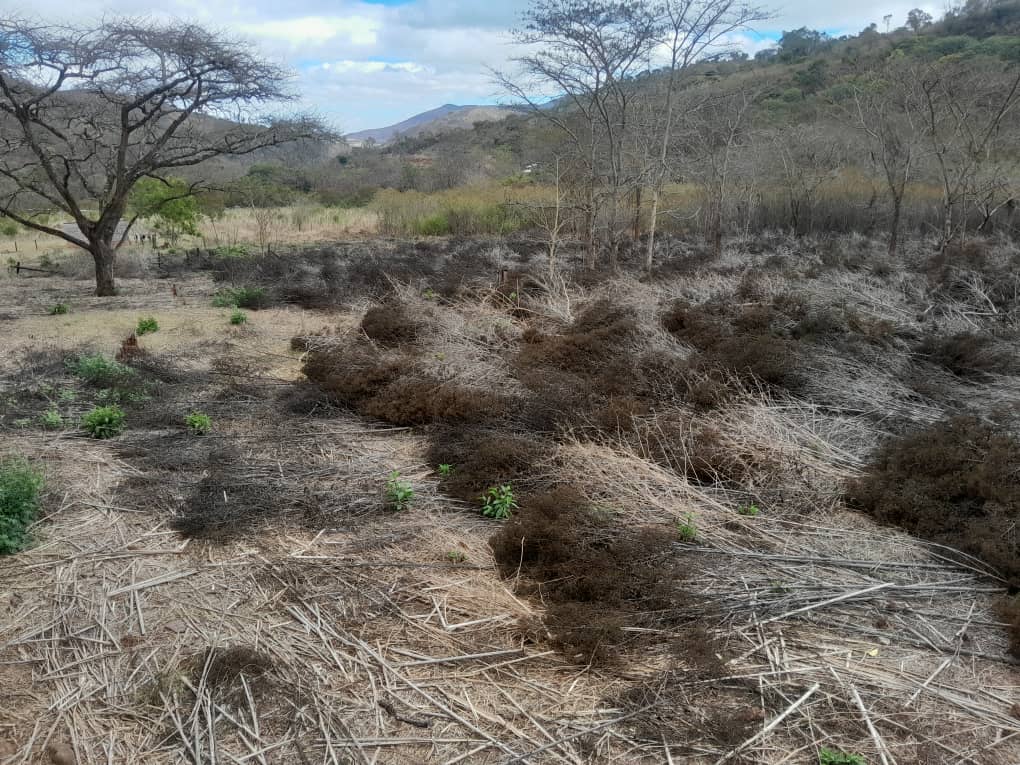
The project also places particular importance on soil health and responsible fertilizer strategies. Improving soil productivity is not only an environmental objective; it is fundamental to maintaining consistent production and crop quality over the long term.
The principle behind the model is straightforward: commercial profitability and environmental responsibility should strengthen one another.
A farm that wastes water, damages soil or relies on inefficient input use may struggle to remain competitive in the long term. By contrast, a production system that carefully manages soil, water, plant nutrition and crop health has a stronger foundation for both sustainability and commercial growth.
Knowledge Transfer: Creating Capacity That Remains Locally
One of the most important aspects of the Climate-Smart Agri Export Project is knowledge transfer.
The project is designed to move beyond short-term technical assistance. Practical farmer training, demonstration plots, crop protocols, production records, mentorship and the development of local supervisors are intended to create agricultural capability that remains within participating communities.
This is particularly important when developing export agriculture.
International markets demand consistency. Farmers and field teams need to understand not only how to grow a crop, but why irrigation schedules, fertilizer applications, crop monitoring, harvesting practices, record keeping and product handling influence final quality.
By building this knowledge locally, the project can create a stronger foundation for future expansion into other crops, production areas and agricultural enterprises.
Creating Social and Environmental Impact
The project's ambitions extend beyond the farm gate.
Commercial agricultural development can create opportunities throughout the value chain, including field production, crop supervision, harvesting, grading, processing, packaging, transport and logistics.
The project therefore seeks to support farmer income, rural employment, local entrepreneurship and stronger agricultural capability while developing internationally competitive production.
Environmental impact is equally important. More efficient water and nutrient use, improved soil stewardship, reduced production losses and more resilient farming systems form part of the project's development philosophy.
The intention is to demonstrate that agricultural exports, environmental stewardship and community development do not have to be competing objectives.
They can form part of the same business model.
International Expertise, Local Implementation and Local Ownership
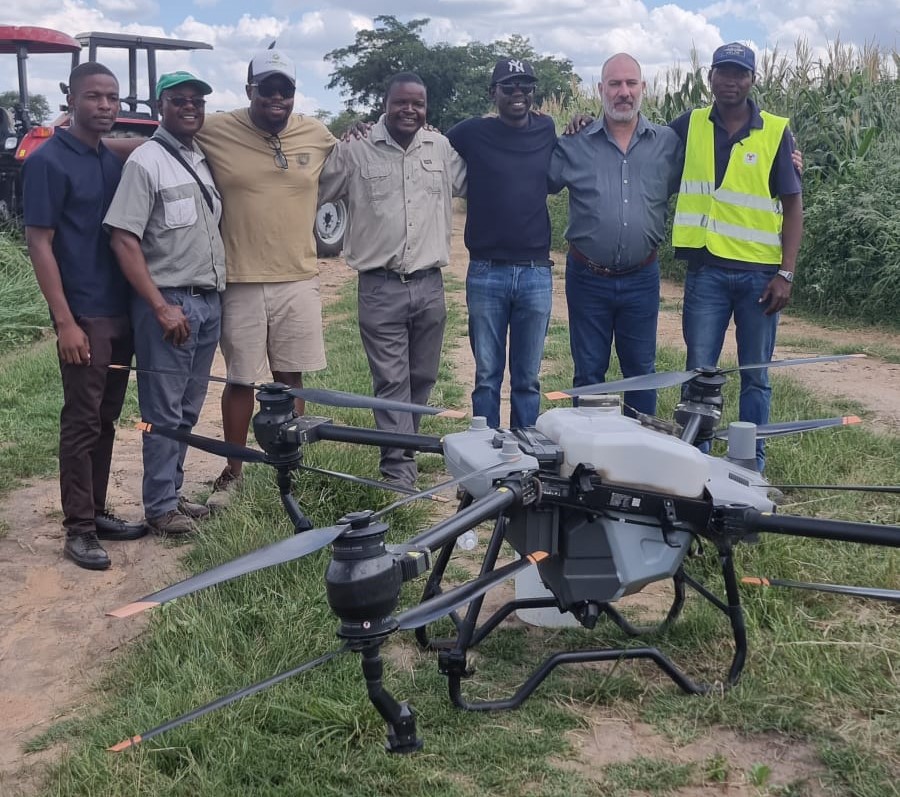
The project brings together complementary leadership roles.
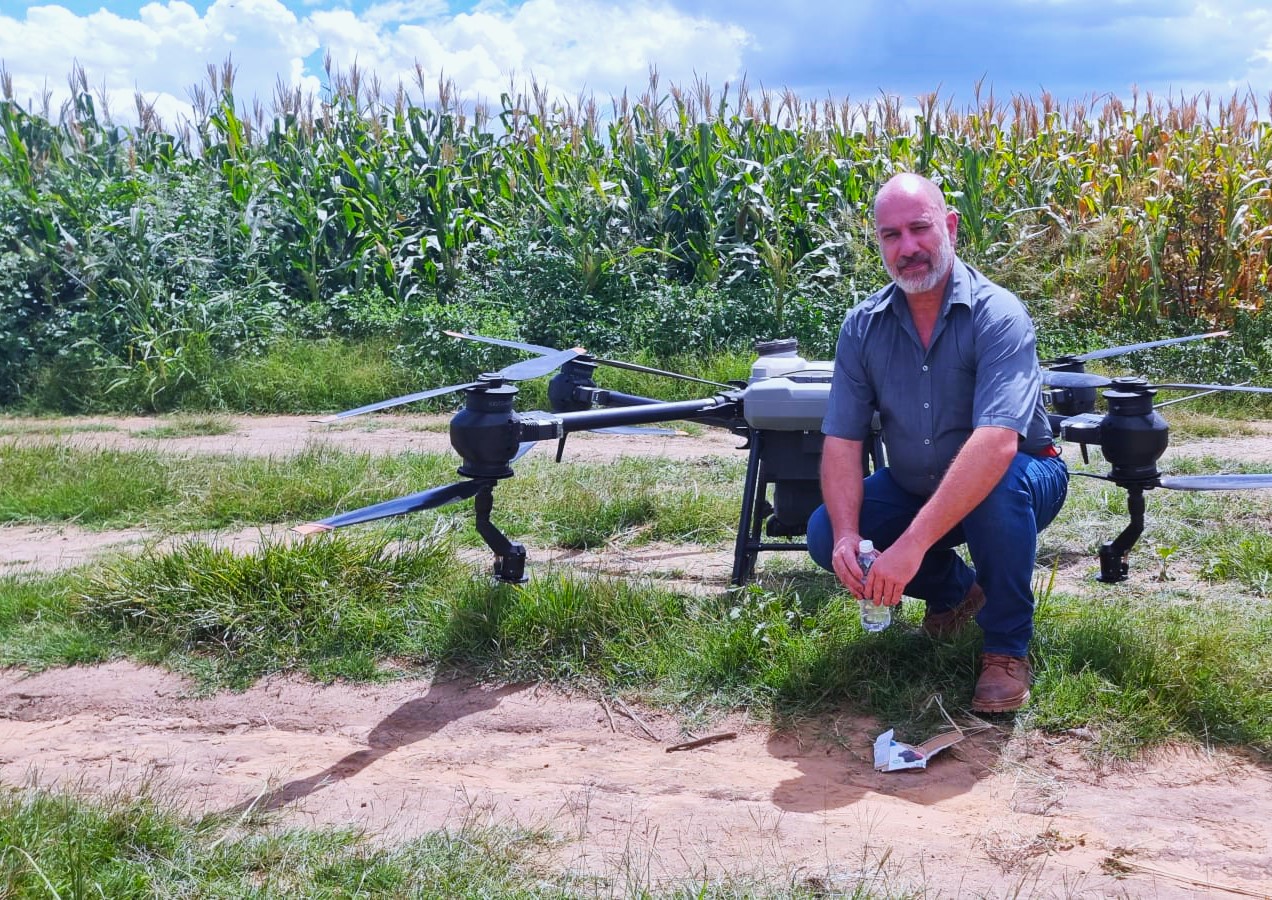
Jurie Geldenhuys of Be Botanical in the Netherlands contributes expertise in agriculture, organic fertilizers and international business development. His role connects crop production and soil-health strategies with farmer capability, commercial planning and export-market development, with particular emphasis on practical knowledge transfer.
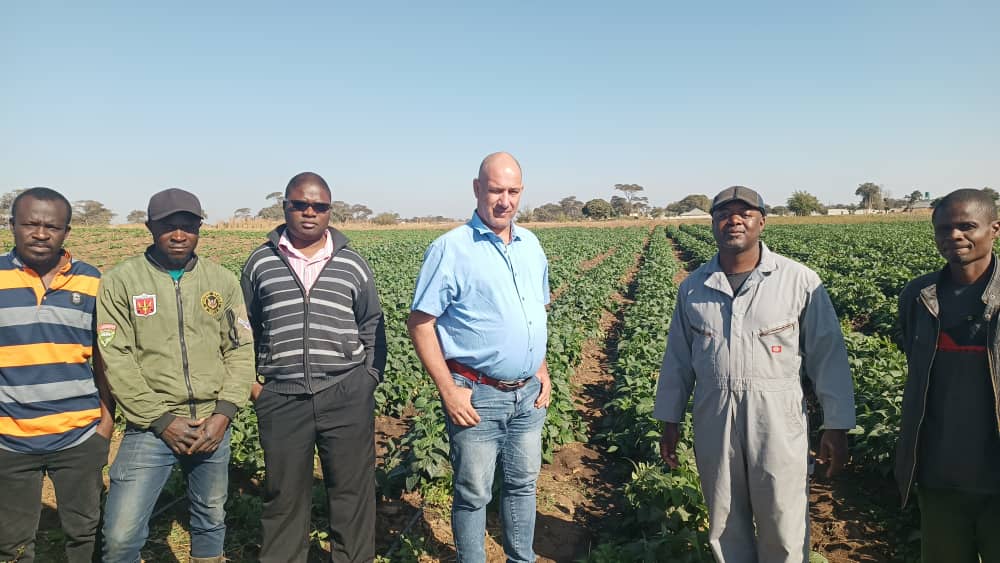
Martin Nyashanu of Agro Afrika, a business of Weirwood Pvt Ltd in Zimbabwe, is responsible for promoting and implementing the project locally. His role includes stakeholder coordination, farmer engagement, field operations and ensuring that the international project concept is translated into workable solutions on the ground.
Dr Archbishop Andby Makururu serves as the project owner, funder and local entrepreneur, providing the ownership and investment foundation required for implementation, strategic direction and longer-term enterprise development.
Together, the leadership model combines international technical and market knowledge with local implementation capacity, entrepreneurship and project ownership.
From Demonstration to Commercial Scale
The project is structured around a four-stage implementation framework.
The first phase focuses on mobilisation and baseline work, including confirmation of land, water, farmer participation, agronomic conditions and market requirements.
The second phase introduces demonstration and training, establishing production plots and developing farmer and field-team capability.
Successful systems can then move into commercial production, where grading, post-harvest handling, traceability, packing and logistics become increasingly important.
The final phase focuses on market growth and scale, including repeat buyers, expanded farmer participation and potential value-added processing.
This staged approach allows the project to learn before expanding and to build commercial scale on proven agricultural and market foundations.
Growing Locally, Creating Global Value
The Climate-Smart Agri Export Project represents more than an initiative to grow Habanero and Turmeric.
It is an attempt to build a practical model for modern agricultural development — one that combines international market access with strong local capability, sustainable resource management and community participation.
Its message captures the broader ambition clearly:
Grow locally. Build knowledge. Create value. Connect quality production to the world.
If the model succeeds, its most valuable product may ultimately be more than the crops themselves. It could be the development of a repeatable system through which Southern African farmers, entrepreneurs and communities can participate more effectively in high-value international agricultural markets.
We hebben je toestemming nodig om de vertalingen te laden
Om de inhoud van de website te vertalen gebruiken we een externe dienstverlener, die mogelijk gegevens over je activiteiten verzamelt. Lees het privacybeleid van de dienst en accepteer dit, om de vertalingen te bekijken.